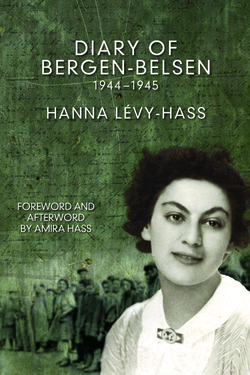
Diary of Bergen-Belsen

A unique, deeply political survivor’s diary from the final year inside the notorious concentration camp.

Hanna Lévy-Hass, a Yugoslavian Jew, emerged a defiant survivor of the Holocaust. Her observations shed new light on the lived experience of Nazi internment. Levy-Hass stands alone as the only resistance fighter to record on her own experience inside the camps, and she does so with unflinching clarity and attention to the political and social divisions inside Bergen Belsen.

Amira Hass, an indispensable voice in her own right as the only Israeli journalist living and writing from with Occupied Territories, offers a substantial introduction and afterword to her mother’s work, which addresses the meaning of the Holocaust for Israelis and Palestinians today.

About the author

Hanna Lévy-Hass was instilled with a passion for freedom and equality while studying in Belgrade in the 1930s. After the Holocaust, she lived in Israel, where she worked as an activist and feminist.

Amira Hass writes a regular column in Ha’aretz newspaper, and is the author of Drinking the Sea at Gaza: Days and Nights in a Land under Siege, and Reporting from Ramallah: An Israeli Journalist in an Occupied Land.

Video

Amira Hass recently received the 2009 Lifetime Achievment Award from the International Women's Media Foundation! Watch her acceptance speech and her most recent interview with Democracy Now!

Watch Amira Hass discuss her mother’s legacy, and the impact of the Holocaust on the present Israeli-Palestinian conflict:

Reviews

“Bergen-Belsen represents the final stage of the Holocaust. At the end of the war, forced laborers too weak to work, Jews from neutral countries, and survivors of death marches from Auschwitz and other camps were dumped together under impossible conditions. After the gas chambers in the death camps were closed down, mass murder continued at Bergen-Belsen through other means. In March 1945, the final month before liberation, nearly 20,000 prisoners died there. Lévy-Hass described this form of genocide in her diary: “the slow, vile, calculated destruction by hunger, violence, terror, and deliberately sustained epidemics”. Her rare description of the final months of the Holocaust is marked by political consciousness, moral understanding, and perceptive observation. Lévy-Hass has much to tell us of death and survival.”
--Steve Hochstadt, historian, Illinois College; author, author, Sources of the Holocaust

"A compelling document of historic importance which shows, with remarkable composure, that ethical thought about what it means to be human can be sustained in the most inhuman conditions. Hanna Lévy-Hass teaches us how a politics of compassion and justice can rise out of the camps as the strongest answer to the horrors of the twentieth century."
--Jacqueline Rose, historian, Queen Mary University of London; author, The Question of Zion

“There are many testimonies of the Nazi concentration and extermination camps, but very few have the quality and the strength of this diary from Bergen-Belsen by Hanna Lévy-Hass. A Jew and a member of the Resistance, Lévy-Hass belongs to the group of detainees that—as Primo Levi emphasized in The Drown and the Saved—had the resources to preserve their humanity against the planned annihilation by the Nazi machine.... The history of the Holocaust is often reduced to a simple conflict between the persecutors and their victims, but it was a much more complex process. It was also the history of the struggle against the barbarism of Twentieth century: and that is the reason why this diary is so important to us.”
--Enzo Traverso, historian, University of Picardie, France; author, The Origins of Nazi Violence