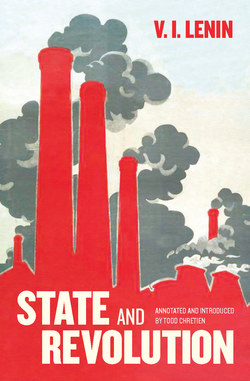




State and Revolution
In 1917, the Russian revolutionary Vladimir Lenin revisited Marx and Engel's views on the state, and realized that their ideas had been distorted by the socialist movement created in their name. It had become axiomatic in the socialist movement, for example, that whereas anarchists wanted to destroy the state, Marx wanted to take it over. Not so, argued Lenin. Marx and Engels argued that the state, as an instrument of coercion, is a product of class antagonisms, and that it represented the state of the dominant class.
The experience of the Paris Commune taught Marx and Engels that "the working class cannot simply lay hold of the existing state machinery and wield it for its own purposes." Rather, the working class must destroy the bourgeois state (with its police, armies, and courts designed to uphold the rule of capital) and replace it with a workers state, a democratically-organized "commune" state. Once class antagonisms had been suppressed and society reorganized on a socialized basis to serve human need, this workers' state would gradually wither away and be replaced by simple administrative functions.
This book puts to rest the idea that Lenin favored dictatorship "over" the working class. For Marx and Engels, the "dictatorship of the working class" was simply the working class armed and organized to prevent the old order from regaining its lost power.