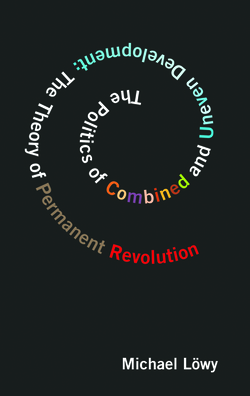
The Politics of Combined and Uneven Development

The Theory of Permanent Revolution

Löwy’s book is the first attempt to analyze, in a systematic way, how the theories of uneven and combined development, and of the permanent revolution—inseparably linked—emerged in the writings of thinkers such as Karl Marx and Leon Trotsky. Such radical reflections permit us to understand modern economic development across continents as a process of ferocious change, in which “advanced” and “backward” elements fuse, come into tension, and collide—and how the resulting ruptures make it possible for the oppressed and exploited to change the world.

About the author

Michael Löwy is research director in sociology at the Centre National de la Recherche Scientifique, Paris. He is the author of many books, including Romanticism Against the Tide of Modernity, and Marxism and Liberation Theology.

Reviews

"Thirty years ago Michael Löwy wrote a brilliant and accessible analysis of the emergence and application of Trotsky's theory of permanent revolution. This new edition of his book is even more relevant read in the context of the revolutionary uprisings in the Middle East today."
Counterfire

"For newcomers and experienced scholars alike, the book serves as an effective short introduction to both the emergence of the [theory of permanent revolution], and it's longer-term consequences in the twentieth century."
Marx and Philosophy Review of Books

"Reading The Politics of Combined and Uneven Development: The Theory of Permanent Revolution by Marxist sociologist/philosopher Michael Löwy was at first like trying to find my way through the Grand Canyon at night: with lost brainwaves traversing the echo-chasms of my mind, bouncing back and forth, unclaimed. But after a short season of intense acclamation to the Mensheviks, Bolsheviks, Bourgeoisie and Proletariat, I found myself secretly becoming a closet neo-Trotskyite. The book, first published in 1981 but shortened considerably for this latest version, is an in-depth look at Leon Trotsky's theory of permanent revolution and how it pertains to different Marxist revolutions through time. Trotsky's theory, which was born from the furnace of the Russian revolution in 1905-06, basically asserts that in order for a socialist revolution to be truly successful, it must progress and mature without becoming stagnant in certain stages by falling into the decay of bureaucracy or backsliding into capitalism. This is a highly academic work, full of mental calisthenics, but for all you other closet neo-Trotskyites it is the shit."
—Karl Travis, Chico News & Reviews