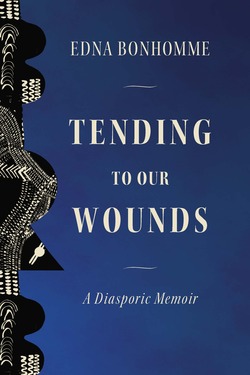
A profound and poetic memoir, tracing the wounds that racism and colonialism have left on Black people across borders.
With astute insight and immersive prose, Bonhomme outlines a personal and political history of life in the United States, Haiti, and Germany, discovering what it means to be Black at home and abroad. She unlearns the lies that she was told about slavery and colonialism and explores how communities are resisting the weight of centuries of history.
Whether examining debt, medical racism, art, or reparations, Tending to Our Wounds cuts a breathtaking course between the past and the present, the individual and the collective—identifying the tendrils of history in the everyday and outlining a path to real freedom.
Edna Bonhomme is a critic, historian of science, and journalist. She earned a PhD in history from Princeton University and holds a Bachelor's degree in Biology and a Master's degree in Public Health from Columbia University. Her writing has appeared in The Atlantic, Esquire, The Guardian, London Review of Books, and The Nation. She is co-editor of After Sex, a literary anthology on abortion and reproductive justice, and the author of A History of the World in Six Plagues. Bonhomme has earned awards from the Andy Warhol Foundation and the Robert Silvers Foundation. She has lived in Berlin since 2017.
ISBN: 9798888906378
Publication date: July 21, 2026
"Tending to Our Wounds is no ordinary memoir. Edna Bonhomme plies her impressive skills as historian and writer to not only tell her stories but to revisit and reconstruct the traumas, revolts, and creativity of those who had once inhabited the places she called home. And in telling their stories she offers a brilliant accounting of what it cost Africans throughout the diaspora to enrich a European ruling class. The bill is past due."
—Robin D. G. Kelley, author of Thelonius Monk: The Life and Times of An American Original
"In Tending to Our Wounds, Edna Bonhomme takes us on a journey that beautifully weaves the personal memories of a Haitian-American, working-class Black woman with the history of colonialism, imperialism, and racial capitalism. As she settles in different cities—Berlin, New York, Cairo, Harlem, Port-au-Prince, Miami—she describes the mechanisms of white innocence, analyzes how racial systems deeply affect the psychic and physical life of Black people, and how people resist. It is a memoir of a political education anchored in her family’s diasporic history, in Black joy and Black struggle."
—Françoise Vergès, author of A Programme of Absolute Disorder: Decolonizing the Museum
"In this expansive, lyrical, and personal book, Edna Bonhomme crisscrosses the earth, tracking the injuries that racial capitalism inflicts, as well as the more-than-reparative logics of resistance that emanate from the 'alien' abolitionist undercommons of various Black diasporas. It is rare to experience memoir, history, and politics braided together so fluidly. A must-read, especially for anyone whose kin have been wounded by captivity and colonialism, or who needs reminding that their solidarity efforts are building, every day, a collective home whose name is freedom."
—Sophie Lewis, author of Enemy Feminisms and Femmephilia
“Tending to Our Wounds traces Bonhomme’s journey across Haiti, Florida, Portland, New York City, Cairo, and Berlin to examine how histories of racism and disenfranchisement shape the present. Melding rigorous research with her own diasporic experience, Bonhomme’s sharp, unflinching language forges links between personal memory and broader structures of power.”
—Tessa Hulls, author of Feeding Ghosts: A Graphic Memoir
Praise for A History of the World in Six Plagues
“A searing attack on historical injustices.”
—Kirkus Review
“Bonhomme’s frank, timely critique of the Western medical field and our faltering health care system reveals how it is deeply entangled with colonialism and capitalism."
—BookPage
“Pandemics thrive on inequities and widen them, providing more kindling for future plagues … if everyone read Edna Bonhomme’s incredible, humane, insightful book—and I hope they do—we might stand a chance of actually breaking the cycle of neglect and panic.”
—Ed Yong
“A breathtaking journey through the intertwined histories of contagions and systemic inequities that have shaped our history. Poignantly insightful and compelling, Bonhomme not only sheds light on past injustices but challenges us to confront our history and envision a more compassionate future.”
—Uché Blackstock
“This meticulously researched book shows us the ways that contagious illness frustrates humankind's instinct for control, and how people have found ways to care for one another in the worst of circumstances. A powerful book that shines a light on the parts of life we'd rather ignore, and the beauty that can arise from horror.”
—Sarah Jaffe
“Edna Bonhomme narrates centuries of the human-microbial dance, laying out how our destinies, liberties, and values are determined by how humans negotiate life on earth with our smallest living neighbors. Brilliant, tender and illuminating.” —Steven W. Thrasher
“An expansive portraiture of how colonialism and confinement have influenced our understanding of illness and humanity. Thankfully, due to the author's talent and sheer strength in combining personal narrative with history, this book is also tender as it tackles some of the most stigmatized subjects of our time."
—Morgan Jerkins
One of the best ways you can support Haymarket is by becoming a member of our subscription program. Receive up to 40 books per year and help ensure the future of radical publishing.
Join today and start your subscription with one or more of these new books!